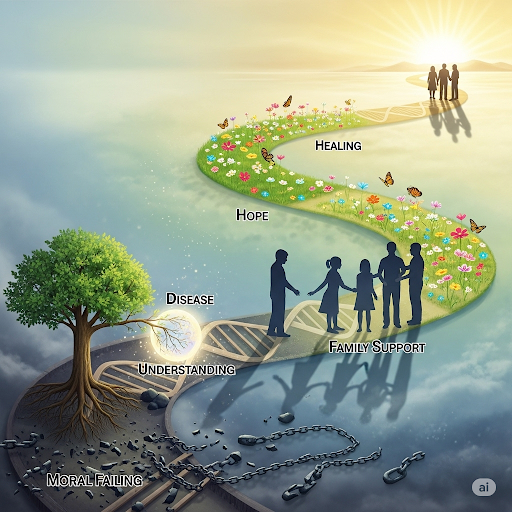
What addiction is and is not. Good morning, everyone, and thank you so much for being here. I know that for many of you, the act of being here today took an incredible amount of courage. I imagine you are carrying a heavy weight—a mix of fear, frustration, maybe some anger, but also… hope. It is so important that you hear this from the very start: you are not alone in this experience. The image on the screen captures the journey we are about to begin. It shows two distinct paths. The lower path is a dark, broken road with shattered chains, rooted in a place labeled 'Moral Failing.' For so many, this represents the feeling of being trapped in confusion, stigma, and despair. But there is another path. A path that begins with Understanding and is built on Family Support. It’s a path that winds through Hope and leads toward a sunrise of Healing. The entire purpose of our day together is to help you build a bridge from that lower road to the upper path. This brings us to the title of our first module: 'What Addiction Is and Isn't'. The most important concept we will establish, the bedrock for everything else, is this: Addiction is a disease, not a moral failing (National Institute on Drug Abuse; Linwood House). It is not a weakness of character or a lack of willpower (Resilience Recovery Resources; Hardee). It is a chronic, complex, but treatable disease of the brain (National Institute on Drug Abuse; Hazelden Betty Ford Foundation). We will discuss the disease analogy, comparing addiction to illnesses like diabetes or heart disease, because this perspective helps remove the blame and stigma that get in the way of healing. We are going to dive into the science behind this disease. We will look at the brain's powerful reward system, the role of key chemicals like dopamine, and how the brain is literally rewired by substance use (National Institute on Drug Abuse; Castle Craig). We will walk through the clear progression from tolerance, to dependence, and finally to addiction (Agape Treatment Center; The Recovery Village). We'll also explore the 'why'—how substance use often begins as prescribed medication for a legitimate pain or injury that eventually becomes the problem. Our goal in this first module is to provide a new perspective, one that replaces judgment with understanding and shame with compassion. This foundational knowledge is what empowers us to move from helpless frustration to effective action. So please, open your workbooks, and more importantly, open your minds. Let’s get started.
This is just the beginning.
The full course includes 60 lessons across 4 modules, an interactive workbook, progress tracking, and a certificate of completion — all for a single payment.